OrbitAce is a Professional Item Removal and Cleaning Company in Bangladesh with more than 50 Item Removal and Cleaning professionals. We have 16 more years of experience in Item Removal and Cleaning Service. We have become one of the fastest-growing Service providers since 2010.
We’re confident, that you’ll love working with us.
Most clients do not “read” a space the way architects do. They respond to what they immediately see. If the photo is busy, their attention goes to the chair, the messy countertop, the signage, the stray cords, or the temporary items on site. Suddenly, the conversation is no longer about the ceiling rhythm, the joinery, the way light falls across a surface, or the proportions of the room. Item removal helps you control the narrative. Clean visuals make it easier to communicate design intent, compare options, and sell the concept. It is also a practical way to reuse real site photography even when the space is not perfectly staged.
Typical outcomes our clients want include: presenting a space without furniture so form and finishes are clear, producing “before and after” visuals for renovation proposals, removing temporary site items from progress shots, or creating marketing-ready images from imperfect real-world photos.


Our service focuses on digitally removing items and cleaning the image so the architecture looks intentional and believable. Depending on your source image and goals, that may include removing:
Furniture such as sofas, beds, chairs, desks, tables, shelving, freestanding cabinets, and outdoor pieces. We also remove decor like rugs, plants, wall art, mirrors, lamps, cushions, and styling accessories. For real environments, we can remove clutter like bins, cables, signage, appliances on counters, personal items, cleaning supplies, and loose construction materials. We can also handle reflections or duplicates where an object appears in glass or glossy surfaces, as long as the underlying detail can be reconstructed convincingly.
When we say “cleaning,” we mean the details that make an image feel professionally finished: patching and rebuilding backgrounds after removal, correcting minor distractions, smoothing inconsistencies, and refining edges so the space looks naturally empty rather than edited. If requested, we can also do light tonal balancing so the final output feels cohesive across a set.
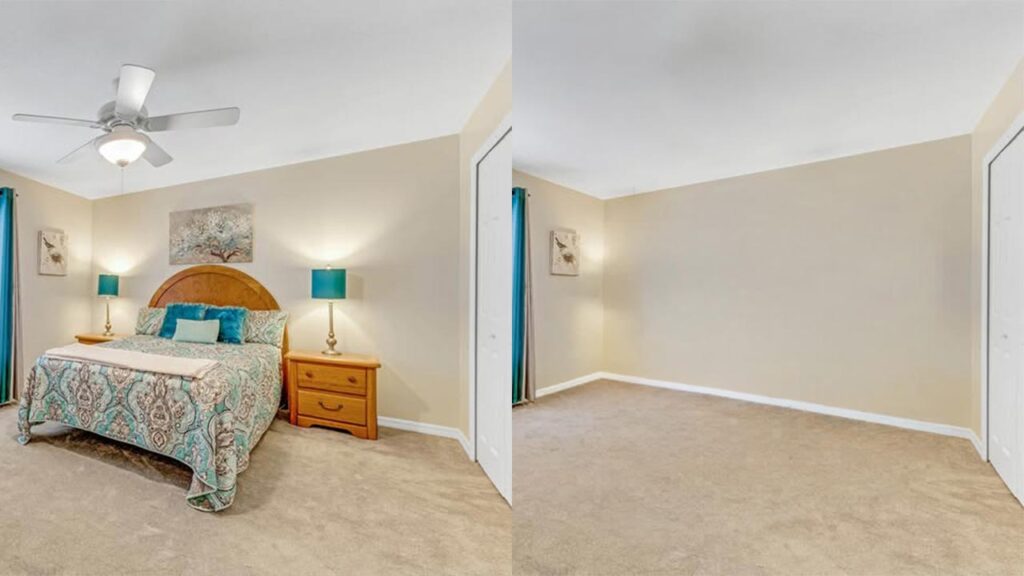
Removing a chair from a lifestyle photo is one thing. Removing a bed while preserving wall alignment, skirting lines, floor pattern continuity, and realistic shadows is another.
Architecture imagery has strict visual rules: straight lines must remain straight, perspective must stay consistent, materials must repeat logically, and the finished photo must still feel like a real camera capture or a high-end render.
Accurate perspective and geometry preservation, careful reconstruction of floors, walls, ceilings, glazing, and built-ins, material continuity (timber grain, tile grids, stone veining, carpet texture, concrete tone), and realistic light behaviour so the space does not feel “flattened” after edits.
If your team is preparing visuals for a client pitch, competition entry, planning documentation, website portfolio, press submission, or a property listing package, this level of precision is what keeps the work credible.
Many architecture and design firms need to show the architecture without furniture for clarity, but they still want the image to look real. We can achieve this virtually by combining advanced retouching and software-based reconstruction, depending on the input.
If you provide real photographs, we use professional editing tools to remove items and rebuild what is behind them. If you provide renders, we can remove objects while preserving the render’s lighting and texture consistency. In some cases, if you have multiple reference shots or a set from the same viewpoint, we can use those as supporting reference to rebuild obscured areas more cleanly.
If you already use specific tools in-house, we can also align our output to fit your pipeline. The goal is simple: you receive an image that looks like the space was photographed or rendered without furniture in the first place.
Architecture teams come to us with a wide range of scenarios. The most common ones include marketing and portfolio imagery where the staging distracts from the space, early client presentations where you want the shell and finishes to stand out, renovation proposals where “existing clutter” makes it hard to read the baseline, and property-focused visuals where the same photo needs multiple versions (staged and empty).
We also often help with project documentation. Sometimes you have a great photo from site, but it includes temporary items like ladders, safety signage, materials, protective coverings, or equipment that pull focus away from the built work. Removing those distractions can turn a “good internal record” into a strong public-facing visual.
We work with a variety of source formats because we know architecture teams do not all produce imagery the same way. You can send high-resolution JPGs, PNGs, and TIFFs for photography and final renders. If you have layered working files, we can also support PSDs in many cases.
If the image is a render from your visualization workflow, send the highest quality output available, ideally with minimal compression. If you have alternate passes (like clay, albedo, or masks) we can sometimes use them to speed up precision work, but they are not required.
The best results come from high-resolution images with clean focus and minimal motion blur. That said, if the shot is important and the resolution is not perfect, we can still review it and advise what is realistic.

We keep the process straightforward because your team is busy and deadlines are real.
First, you send the images and mark what needs to be removed. This can be as simple as a short note, or annotations on a PDF, screenshot, or markup layer. If you want multiple versions (for example, fully empty and “lightly decluttered”), tell us upfront, and we will structure the delivery accordingly.
Next, we review feasibility and confirm timing. Some removals are quick. Others require detailed reconstruction of complex floor patterns, reflections, or repeated textures. We will confirm what is achievable and what will look natural.
Then we edit and deliver a preview for review. If you need small adjustments, we handle revisions so the final aligns with your intent. Once approved, we deliver final files in your preferred format, sized for web, print, or presentation.
To begin, send us the images, the output size you need (web, print, or both), and a clear list of items to remove. If there is a particular architectural element you want to emphasise, tell us that too. For example, if the key story is the stair, the glazing line, the ceiling feature, or the material junction, we will make sure the cleanup supports that focus rather than competing with it. If you have examples of your preferred visual style, even from past projects or references, sharing those helps us match your expectations faster.
Furniture and objects have their place, but they should never be the reason a client misses the design. Our Item Removal and Cleaning Service helps architecture and design teams present spaces clearly, professionally, and without distractions, using a virtual workflow that keeps images believable and aligned with real geometry and materials.
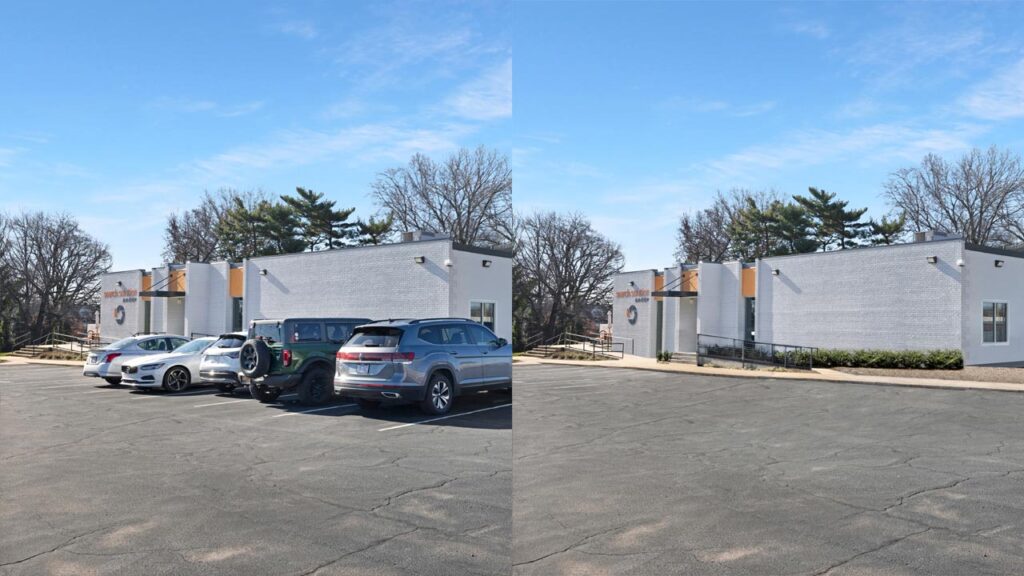
Real estate photo editing can remove distractions such as power lines, vehicles, trash bins, cords, reflections, construction materials, personal items, and unwanted people. Professional editing preserves realistic lighting, shadows, and architectural details while cleaning the image. High-resolution photos with minimal obstruction produce the most natural and believable results for property listings and marketing materials.
Real estate editing projects typically accept JPG, PNG, TIFF, RAW, MP4, MOV, and HEIC file formats. JPG and PNG files work well for standard photo edits, while RAW and TIFF files preserve maximum image detail for advanced object removal and architectural corrections. Video editing projects commonly use MP4 or MOV files recorded from iPhones, drones, or professional cameras.
Yes, you can request several versions of the same real estate photo. Multiple copies can include different staging styles, object removals, lighting adjustments, sky replacements, seasonal variations, and social media crop formats. Creating multiple versions helps agents and developers test marketing styles across MLS listings, Instagram, Facebook, and advertising campaigns.
Yes, large furnishings can be removed while keeping the architecture realistic and believable. Professional real estate editing uses object removal, perspective correction, and AI-assisted retouching to preserve walls, flooring, windows, and natural room dimensions. Clean removals work best with high-resolution footage, stable camera movement, and unobstructed architectural details.
Yes, real estate editing can use both real photos and architectural renderings. Real photos showcase the actual property, while architectural renderings visualise renovations, unbuilt spaces, or staged interiors. Combining both formats helps agents, developers, and architects present realistic property layouts, design concepts, and marketing visuals across listings and social media campaigns.
Yes, staged rooms can be converted into empty room images using virtual decluttering and furniture removal editing. Professional real estate editors remove furniture, decor, rugs, and lighting while preserving walls, flooring, shadows, and architectural proportions. High-resolution photos with clear room visibility produce the most realistic empty-space results for listings and renovation previews.
About us
OrbitAce is a professional CAD, 3D rendering, BIM modeling, and real estate editing company. We provide quality services for architects, builders, designers, contractors, and real estate businesses. Our services include CAD Conversion, Virtual Staging, Real Estate Image Enhancement, Interior Rendering, floor plans, BIM modeling, and video editing. We focus on quality work, fast delivery, affordable pricing, and customer satisfaction.
100% Satisfaction


Important Links
Contact us
Email: info@orbitace.com
Phone: +8801681866775
2nd floor, Block#A, Abujor Manjil, 5/6 Road no# 7, Barishal 8200, Bangladesh